| |
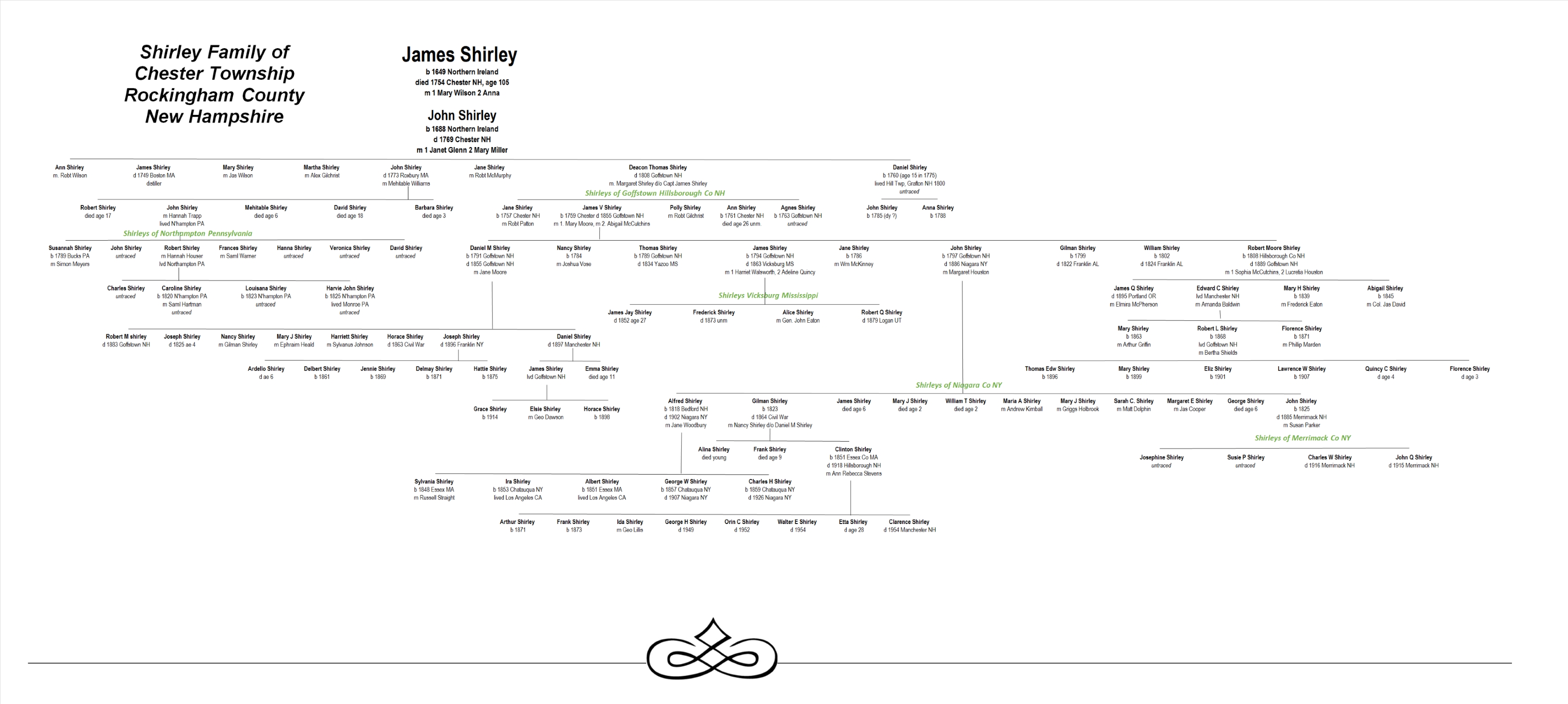
James Shirley born
about 1649. He lived in Londonderry Northern Ireland and came
to America in 1730 at age 76 and settled in Chester, New Hampshire.
He was 105 years old when he died in 1754. He is believed to
be of Scotch origin. He came to America with Scotch-Irish
and probably with the Gilchrists as they early intermarried and
lived in Chester and belonged to the same Presbyterian Church
at Chester under the pastorate of Rev. Ebenezer Flagg at Long
Meadows, and afterwards when the church divided, they were members
of another Presbyterian Church under the Pastorate of the Rev.
John Wilson near Londonderry New Hampshire. this was in
the southeast part of Chester on what was known in the early
history of that town as Home Lots.
The first ancestor of the New
Hampshire Shirleys of whom we have any record, was James Shirley,
who was born, probably in the north of Ireland, in Ulster County,
in 1649. This was the year that Cromwell send his famous Ironside
Legion into Ireland, and avenged the terrible massacre of the
Protestants in 1641. It is not improbable that the ancestor of
James Shirley, if not James himself, came from Scotland to Ireland
in one of those currents of emigration that set out from one
country to another, as the waves of religious persecution swept
hither and thither, as Catholic or Protestant was in the ascendant.
It is even possible that James Shirley, as well as his ancestors,
may have been a native of Scotland, and with his parents, have
been among the exiles driven from Scotland, in 1660, under the
cruel persecution of James Graham, of Claverhouse, who was the
tool fo James, viceroy of Scotland and brother of James II. These
immigrants from Scotland were Presbyterians. Fifty years before,
in 1612, many of their ancestors had settled in Ulster, on lands
confiscated upon the overthrow of the Earl of Tyrone, who had
rebelled against James I. This immigration kept up until 1641,
when the hatred of the natives had so increased that it culminated
in an attempt to exterminate the entire Protestant population,
and in the attempt forty thousand Protestants were slain. His
massacre was avenged by Cromwell, who, for the first time, brought
all Ireland to England's feet. For forty years more the Scotch
and Irish lived side by side in the north of Ireland, always
hating and always at feud with each other. The expulsion of James
II from the throne of England, in 1688, was followed by the accession
of William III, and a new religious war in Ireland, the Catholic
Irish supporting James, and the Presbyterian Scotch rallying
about the standard of William. It was during this turbulent period--1690-91--that
the famous siege of Londonderry occurred. William triumphed,
and the battles of the Boyne and Aughrim the cuase of James and
the Catholics was overthrown. But the brave defenders of Londonderry
fared but little better than their Catholic besiegers. The acts
passed in the interest of the Church of England bore as heavily
against the Scotch Presbyterians as against the Irish Catholics.
Many emigrated, and among the number was the faithful band that
settled Londonderry [NH]. They sailed in five vessels, and landed
in Boston, August 4, 1718. That winter they passed in Casco Bay,
suffering terribly. The next year they heard of Nutfield, on
the Merrimack [River], settled there and renamed it Londonderry.
Thence they spread, and they and their children became the pioneer
settlers of Derry, Chester, Windham, Bedford and Goffstown. James
Shirley arrived in Chester in 1730, at the great age of seventy-six,
bringing with him a full-grown family. He was a farmer, and is
chronicles as living to the extraordinary age of one hundred
and five years. It will be seen that the Shirleys sprang from
a hardy, industrious, reliant and long-lived ancestry.
married 1) Mary Wilson
married 2) Anna _______.
children:
 1(i). John Shirley born 1688
Ireland. He died 1764 Chester New Hampshire He is living
in Chester upon land he purchased from Samson Underhill and where
he lived until his death. From here, the Shirley family of Goffstown
New Hampshire 1(i). John Shirley born 1688
Ireland. He died 1764 Chester New Hampshire He is living
in Chester upon land he purchased from Samson Underhill and where
he lived until his death. From here, the Shirley family of Goffstown
New Hampshire
married 1) Janet Glenn
married 2) Mary Miller, the widow of Archibald Miller
1(ii). James Shirley born about 1690 Ireland. He supposedly
died 1700
1(iii). Thomas Shirley born about 1692 Ireland. He supposedly
died 1701
1(iv). Hugh Shirley born about 1694 Ireland, nothing more
known
1(v). Robert Shirley born about 1696, nothing more known
1(vi). Henry Shirley born about 1698. According to tradition,
he went in 1733 from Boston Massachusetts to Jamaica in the Brigatine
SARAH. nothing more known
1(vii). Captain James Shirley  born December
1700 in the Province of Ulster, Ireland and died May 30, 1796
Chester, New Hampshire, nearly 90 years old. They first
lived in Brookline Massachusetts and in 1734 moved to Chester,
NH where they bought Addition Lot #11. He was known as the 7th
son and was famous for curing "King's Evil" or scrofula
by the stroke of the hand. born December
1700 in the Province of Ulster, Ireland and died May 30, 1796
Chester, New Hampshire, nearly 90 years old. They first
lived in Brookline Massachusetts and in 1734 moved to Chester,
NH where they bought Addition Lot #11. He was known as the 7th
son and was famous for curing "King's Evil" or scrofula
by the stroke of the hand.
married Janet
Shirley in 1726 Ireland.
1(viii). Thomas
Shirley born about 1710. He died 1776 (He was a half
brother of John 1. and Captain James 2.). He lived in several
places. He did live on Lot #51, but settled at what is now Auburn
Village. On Dec 25, 1775 he had an altercation with an old settler
and was wounded in the head. It was not considered dangerous
at first, it eventually proved dangerous for he died Feb 1st,
1776.
married Mary Hunter
Is there another
brother Alexander Shirley [the elder] born 1717, died on Noodles
Island Chelsea, Suffolk Co Mass in 1800? Children christened
at Christ Church Boston. Clearly involved with Thomas Shirley
of Chester NH's children
With James-1 Shirley came three
sons, -- John-2, James-2 and Deacon Thomas-2. Captain James-2
Shirley, who died in 1796, was a seventh son, and famous for
curing king's evil (or scrofula) by the stroke of the hand. Thomas-2
was born in Ireland in 1728, and died in Goffstown in 1808, aged
eighty years. His son, James-3, was born in Chester in 1759,
and died in Goffstown, March 31, 1855, aged ninety-six years.
He married Mary Moore, daughter of Colonel Daniel Moore, an officer
in the Revolutionary War. For his second wife he married Mrs.
Abigail McCutchins, the mother of Moses and General Luther McCutchins,
Mrs. John Swallow and Mrs. Robert M. Shirley. Their children
were Nancy-4, Jane-4, Thomas-4, Daniel M-4, John-4, Gilman-4,
William-4 and Robert M-4.
Nancy-4 Shirley, born 1784; died December 12, 1818; married Joshua
Vose, of Bedford; children,--Joshua, Daniel, James and Nancy.
Jane-4, born 1785; died December 9, 1865; married William McKinney,
of Newberg, Ind.; children,--Margaret, born 1806; Mary, born
1808; John, born 1810; James, born 1810; William, born 1814;
Thomas, born 1817; Joshua, born 1819; Nancy, born 1822; Harriet,
born 1825; Martha, born 1828; Cornelia, born 1830; Cordelia,
born 1830.
Thomas-4 Shirley born 1789; died May 13, 1834. He was a teacher,
and died at Satassia, Miss., aged forty-five years. He never
married.
Daniel M-4 Shirley, born 1791; died August 23, 1855; married
Jane Moore, daughter of Robert Moore, of Bristol. He was a farmer
and lived on a part of the original homestead farm on Shirley
Hill, the house on which, still standing, was the second two-story
frame house built in town. Their children were: Robert M., born
November 24, 1819; died April, 1883; married Margaret Dodge of
Goffstown.Nancy, born December 26, 1823; married Gilman Shirley;
children,--Alma, born 1849; Frank, born March 29, 1854; Clinton,
born October 6, 1857.
Mary, born May 10, 1826; died December 1, 1869; married Ephraim
Heald; children,--George, born 1849; Hattie, born July 8, 1852.
Joseph, born April 22, 1831; married Nellie Niles, of Bombay,
N.Y.; children,--Ardello, born 1859, died 1865; Delbert, born
1861; Jennie, born 1869; Delmay, born 1871; Hattie, born 1875.
Harriet, born April 2, 1835; married Sylvanus D. Johnson; children,--Cora
Belle, born February 10, 1859, died July 12, 1859; Horace Shirley,
born October 22, 1867, died October 12, 1869; Shirley Moore,
born January 8, 1869; Helen Inette, born February 2, 1871.
Daniel, born September 26, 1838; married De Ette Sackett, of
Potsdam, N.Y.; children,--James, born February 23, 1876; Emma
De Ette, born July 4, 1879.
Horace, born March 19, 1841; enlisted in Company G, Sixteenth
New Hampshire Volunteers; drowned in Vermillion Bayou, La., April
17, 1863, at the age of twenty-two. He was one of the thousands
of noble and patriotic youths who gave their lives to their country
in the war which saved the Union and freed the slave.
James-4 Shirley, born May 5,
1794; died August 8, 1863. He graduated at Dartmouth College,
read law at Albany, N.Y., but soon left for Augusta, Ga., resuming
studies and having charge of an academy there. He began practice
at Florence, Ala., and pursued it at Huntsville, Ala, but finally
settled at Vicksburg. His character was unblemished, his benevolence
exalted and his loyalty to the Union uncompromising. It was at
his plantation that the interview occurred between Generals Grant
and Pemberton, which led to the surrender of Vicksburg. He married,
first, Harriet, daughter of James Walsworth, of Norwich, Conn.,
in 1820. In 1835 he married Adeline, daughter of Abraham Quincy,
of Boston, Mass. James Jay, oldest son of James and Harriet Shirley,
was born in 1825, died 1852. His widow Harriet, and daughter
Emma (Mrs. Andrew Criddle), reside in Clinton, Mass. Children
by second marriage,--Frederick, born 1836, died 1873 unmarried.
Quincy, born 1848, graduated at West Point, died 1879, he married
Margaret Parks. Alice, born in 1844, married General John Eaton,
United States commissioner of education, their children are,--James
Shirley, born 1868; Elsie, born February 6, 1871; John Quincy,
born 1873.
John-4 Shirley, born 1797; married Margaret Houston; lives at
Suspension Bridge, N.Y. Children,--Alfred, born 1819; married
Jane Woodbury. Maria, born 1827; married Andrew Kimball; their
children,--Lauron H., born 1850; Emma J., born 1852, died 1876;
Ella F., born 1854, died 1877; Clara M., born 1857, died 1881;
George A., born 1859; John S., born 1855, died 1861; Gilman,
born September 20, 1823, married Nancy Shirley; member of Company
G, One Hundred and Twelfth New York Volunteers, killed in battle
of Cold Harbor, Va, June 2, 1864. John Shirley died May 10, 1855;
married susan Parker, of Hooksett; children,--Josephine, born
1849; Charles, born 1850; Quincy, born 1858; Susey, born 1862;
Mary Jane, born 1823, married Griggs Holbrook, member of One
Hundred and Seventieth New York Volunteers, died in Andersonville
prison; married, second, Joseph H. Stevens, died 1880; children,--Margaret
Abbie, born 1866; Alice Maria, born 1868; John Hadley, born 1870;
Fred Hodgman, born 1873; married, third, Andrew Kimball. Sarah,
born 1836; married Matthew Dolphin; died 1869; children,--George
Alfred, born 1867; Carrie Shirley, born 1869. Margaret, born
1840; married James Cooper, 1863; children,--Thomas Shirley,
born 1865; John Maxwell, born 1867; Ella Margaret, 1869; Robert
James, 1871; Mary Emma, 1874.
Gilman-4 Shirley, born 1799; died at Gilmanton Academy, Franklin
County, Ala, August 18, 1822, aged twenty-three; unmarried.
William-4 Shirley, born 1802; died at Courtland, Franklin County,
Ala, August 25, 1824, aged twenty-two.
Robert M-4 Shirley, born January 5, 1808; married Sophia McCutchins,
born April 15, 1805, died December 6, 1870; married, second,
Lucretia Houston, born July 20, 1820. For fifty years Mr. Shirley
was one of the prominent farmers and business men of the county.
He is now retired from active business, and in his retirement,
as in his active life, is distinguished for his kindness, integrity
and liberality. He was a seventh son, famous for curing king's
evil. Children (by first wife),--James Quincy-5, born November
14, 1829; married Elmira McPherson, of Bedford; educated at New
London; went to California in 1850, at the age of twenty; engaged
in mining and stock raising in California, Idaho, Utah and Oregon;
a pioneer and successful operator in the latter business. At
the early age of twenty-one he drove a large herd of cattle from
Council Bluffs to San Francisco.
Mary Helen-5, born May 23, 1839; married Frederick Eaton, dry-goods
merchant of Toledo, Ohio; child, Helen, born Augut 5, 1866, died
April 13, 1876.
Abigail Frances-5, born November 21, 1844; married Colonel James
B. David, of Amherst; resides in Somerville, Mass; child, James
Quincy, born May 30, 1874.
Edward Carlton Shirley-5, born December 5, 1834 in Goffstown,
N.H.; married Amanda Malvina Baldwin (April 24, 1862), daughter
of Deacon Nahum Baldwin, of Manchester; children,--Mary Vicksburg-6,
born July 4, 1863, the day of the fall of Vicksburg; Robert Lawrence-6,
born May 12, 1868; Florence Sophia-6, born February 17, 1871.
Colonel E.C. Shirley is one of
the best known and most prosperous farmers in the State. He tills
the homestead farm on Shirley Hill, which he has improved and
brought to a high state of cultivation. His occupation is that
of his immediate and remote ancestry in an unbroken line, and
which has so strikingly conduced to longevity in this family.
His home combines the attractiveness of rural life and the happiness
of the domestic circle, united with a generous hospitality and
troops of friends. Colonel Shirley was educated in the district
school until he was eighteen years of age, and was then sent
to New Hampton, where he remained until the breaking up of that
school. He then went with Professor Knight to New London, where
he remained three years. After leaving school, Colonel Shirley
went to California in 1856, where he remained two years, engaged
in various employments. Returning to New Hampshire, he was engaged
in lumbering operations until 1862, when his father moved to
Manchester, leaving the homestead to his care and possesssion.
Colonel Shirley has always taken an active interest in military
and agricultural affairs. He has held a commission as second
lieutenant in the Amoskeag Veterans, aid-de-camp to Governor
P.C. Cheney, with the rank of colonel, and on "New Hampshire
Day," at the Centennial at Philadelphia, was officer of
the day. He was also assistant quartermaster on the staf of Brigadier-General
Clough, New Hampshire National Guard. He is a member and trustee
of the New Hampshire Agricultural Society, and chief marshal
at four exhibitions. He is also one of the founders of the Piscataquog
Valley Agricultural Association.
|

 James Shirley