| |
This Lineage Page Last
Reviewed and Updated October 2020 (more needed)
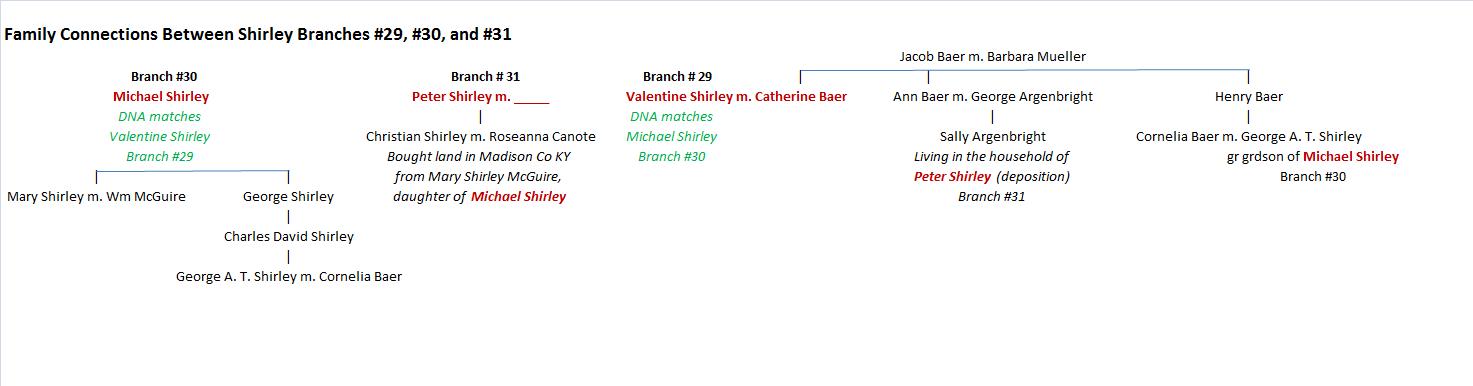
Valentine Shirley  was born in Pennsylvania
in 1740-1750's and died in Augusta Co. Virginia in 1811. was born in Pennsylvania
in 1740-1750's and died in Augusta Co. Virginia in 1811.
Valentine Shirley
appears to be of German descent and Catherine was a member of
a Swiss-German family who also lived in Virginia. He was a successful
farmer. Aug 10, 1777 Felty Shirly recommended for Ensign. Felty
was a nickname for Valentine. Feb. 17, 1778 Valentine was commissioned
Ensign in the militia. This reference and the Oath of Qualification
have been the basis for membership of his descendants in the
DAR. Aug 18, 1778 Vaentine Shirly and Jacob Barrier (Baer) appointed
road surveyors. Nov 16, 1779 Grand Jury presentments against
Valentine Shirley and forty three others for retailing liquors
without a license. On June 8, 1811 Valentine sold his
land in Augusta Co. VA and on July 8th, 1811 he entered 480 acres
in Orange Co. Indiana. It is not known if he made the trip to
Orange co. Indiana or not as he made his will Sept 3, 1811 in
Augusta Co. VA and was in low health. His will was
probated Sept 23, 1811.
married Catherine
Baer and
they were the parents of eight children.
children:
1(i). Mary
Barbara Shirley
born April 12, 1772 VA, died 1831 IN, married Samuel Baker Sept
24, 1791. He was born May 1770 PA and died April 1842 IN. He
was the son of: Phillip Peter Baker Dec 23,1723 Germany, died
Mar 1, 1801-1801 and Barbara Schubic. Phillip was the son of
Johann Nicholas Backer (Baker) who married Anna Marie Schawnee
Jan 1723. Johann is said to have farmed in Frederick Co. VA before
1755. His will is written in German and probated in 1762. (see
MISC INFO link at the top of this page for a pedigree of this
family)
1(ii). Jacob
Shirley
born Feb 9, 1774 VA, died
Dec 2, 1859 IN. Shirleys
of Orange Co Indiana
About 1814, Jacob and Sally made
the long journey to Indiana, bringing with them their infant
daughter born in 1814. Jacob first purchased land in Orange
County Indiana on Feb 11, 1815. He and his wife made their
home on this land, which was adjacent to lands entered by his
brother Henry and by Thomas Sewell, husband of his sister, Anna
Shirley. After the death of Anna and Thomas Sewell, Jacob
Shirley was named guardian of their children. In 1816, the first
school in Orangeville Township was established at the Shirley
place. In 1837 Jacob and Sally deeded 3 acres of their land to
the school district of Congressional Township for $1.00. Sometime
between 1815 and 1820, a log mill was built by Jacob Shirley
at the rise of Lost River, which was also known as the Big Spring.
This mill was run by an undershot wheel which had one set of
burrs on which corn was ground. The top of
the burr of this mill was one solid stone taken from the vicinity
of Cave Spring. It is of flinty limestone. This was the first
mill on lower Lost Rive, and it was greatly needed to grind the
corn to make meal for the first settlers in this vicinity. Jacob
died in 1859...nearly 7 years later and Sarah in 1861. They are
buried in a cemetery on the property in Section 7 that they once
owned and which Valentine Shirley had entered in 1811. Jacob's
brother Henry had been buried there in 1847. Jacob's Bible
was printed in 1833 and is now located in the Museum of the Spring
Mill State Park, Mitchell Indiana. It records the dates of births,
marriages, and deaths of members of Jacob's family and also dates
for the family of his sister, Anna Shirley Sewell. It is said
that Jacob did not care to live in a log house. He built a house
which was pronounced by travelers as the best house in the Ohio
River Valley at that time. A large part of the house was
still standing and in use in 1920. It is also said that Jacob's
personality was sometime arrogant and overbearing. One winder
when the wheat crop had failed and the people were really suffering
for want of flour, Jacob Shirley has a large quantity stored
in his mill, but he refused either to grind or sell it except
at an exorbitant price. He hoarded the grain for two or
three years, until it deteriorated and the crops were again plentiful
and the prices consequently lowered. Jacob Shirley was a horse
fancier. In his later days he went to Virginia and came back
with a span of trotters, equipped with fine brass studded harnesses
and hitched to a splendid carriage. The horses were a bit too
much for the old gentleman to manage, however, and he sent back
to Virginia for a Negro coachman. Since he could not hold the
man as a slave in Indiana, he freed him and built a cabin for
him and his wife, and allowed them a tract of land to cultivate
as long as they lived.
1(iii). John
Shirley
born Aug 2, 1776 VA, His will
dated Oct 3, 1835 and recorded Dec 25, 1835 Lincoln Co. MO. He
bequeaths to John Foster all my right and interest in the following
named negroes (8)....and all personal property.... and he is
to pay my brothers, Henry and Charles Shearly. Wit: William
Highsmith and F.K. Duncan. Shirleys of Grainger Co TN and Lincoln
Co MO
Soon after their marriage, John
and Ann Shirley moved to Grainger Co. TN. There a number of deeds
in his name from 1809 to 1828. They show he
owned considerable land including some lots in Rutledge. One
property of 30 acres was called the "John Shirley sawmill
tract". He is listed in the 1810 census with
his wife, age 26-45 and with one boy and one girl, both under
10 years of age. Unfortunately, there is no 1820 census as they
were destroyed in a fire. They do not appear in the 1830
census of TN. In Nov 1811 John was in Augusta Co. VA participating
at the auction of his deceased father, Valentine. He purchased
a bed and furniture for $12.50, a money scale $1.75, a coffee
mill $1.12, some vials and bottles $5.25. In
August 1814 John and Ann signed an affidavit in Grainger Co.
TN relating to Valentine's estate. Before the death of
his mother in 1834, he had borrowed substantially from her. In
the final settlement of her estate in 1844-6 the Orange County
IN court papers mention "the unknown heirs of John Shirley".
The court also determined that John Shirley "was and is
entirely insolvent, "and that his unknown heirs would not
receive any share of the estate. The last record for him
was a sale on Feb 8, 1828 of two adjoining parcels of 100 acres
each, one being land he bought in 1810.
1831, Summary Depositions, in the case Catherine Shirley
vs. John Shirley heard in the Circuit Court of Lincoln County,
Missouri. There is a deposition for Jacob Shirley (1774-1859)
and Charles Shirley (b. 1782) which were taken in Orange County,
Indiana. Also included is a dedimus authorizing any judge or
justice of the peace to take testimony of anyone having knowledge
of the case. The suit was brought by Catherine Shirley (d. 1834)
of Augusta County, Virginia and later Orange County, Indiana
against her son John Shirley (1776-1835) of Lincoln County, Missouri
for his alleged failure to pay money owed her. Cite As Shirley
Family. Depositions, 1831. Accession 40500, Personal papers collection,
The Library of Virginia, Richmond, Va. 23219. Biog./Hist. Note
Catherine Baer was the daughter of Jacob and Barbara Baer of
Rockingham County, Virginia. She married Valentine Shirley. They
resided in Augusta County, where he died in 1811. Afterwards,
she moved to Orange County, Indiana where she died in 1834. Library
of Virginia Archives
1835 Will of John Shearly,
dated Oct 3, 1835. Bequeath to John Foster all my right and interest
in the following named negros Slave Milly and her children Henry,
Lot, Alcy, Ben, Caroline, Sarah Jane and youngest and all personal
property.... and he is to pay my brothers, Henry and Charles
Shearly. Wit: William Highsmith and F.K. Duncan.
Recorded Dec 25, 1835. (A-40) Will Book "A" & "B",
1825 - 1855
married Ann Scott Oct 1, 1801 Rockingham Co. VA.
Names of Children not Known....
1(iv). Henry
Shirley
born March 26, 1779 VA, Named in the
1835 will of his brother John Shirley; He died Dec 22,
1847, Shirleys
of Orange Co Indiana
Henry came to Indiana about 1809
according to his grandson, William C. Shirley. He located in
Jackson Twp. in Washington Co. northwest of New Albany where
his sister, Barbara and her husband Samuel Baker had settled.
It was probably here that he met his wife, Catherine Wyman. She
was the daughter of Henry and Catherine (Kern) Wyman who had
come to Jackson Twp in 1807 from KY. Henry volunteered
in the War of 1812. He served as a private in Capt. Hiram C.
Boone's Company, Fifth Regiment Indiana Militia from Aug 21,
1812 to Sept 28, 1812. He was paid $8.59. Any other details
of his service are unknown. Henry and Jacob lived together
for a time on land bought by their father, Valentine, who had
died in 1811. These two brothers with families arrived too late
to clear ground and put in crops. Henry built a double log house
with chimney between and fireplaces to face each room. There
were two large rooms. This was one and a half stories high with
porch running the full length of the house. Henry was active
in the Methodist Church. In the history of Orange Co. it is stated
that the society now known as Wesley Chapel was called at its
organization, Bruner's Chapel, organized before 1830 probably
at the home of Henry Shirley. The first meeting was held at the
Henry Shirley schoolhouse, and afterward at the home of A. Bruner......
Among the early members of this church were Henry Shirley, his
wife, mother and family, Nathaniel B. Wilson... and others. In
1837 Henry Shirley was a trustee of the Methodist church of Paoli.
In the late 1830's, Henry Shirley, his wife and all of his children,
except George, moved to Richland Co. IL. Her he owned 480
acres upon which he farmed until 1846, when his health failed.
He then returned with his wife and daughters, Harriet and Susan,
to his farm in Orange Co. IN near his son George. Henry did not
execute a will until the day he died. The will was probated Jan
4, 1848 with bond of $4000 provided by his son George Shirley
and son-in-law, Andrew Wilson, executors. Henry's will (Book
3 page140) specified that his wife Catherine should have such
articles of his personal property as may be most convenient for
her lifetime. The remaining articles should be sold and the proceeds
distributed... 1/3 to Catherine and rest divided equally between
his 7 living children and his grandson Henry Brassie, son of
deceased daughter, Ann. The will specified that wife Catherine
should receive all of Henry's lands in Orange Co. IN for her
lifetime after which they should be sold and proceeds divided
among the 8 heirs. This provision was corrected later, and court
records show that at least 210 acres were sold soon; 170 acres
to Susan and her husband, Enos Halbert. Henry's land in Martin
Co. should be sold and proceeds divided among the 8 heirs. This
amounted to 520 acres. Additional bequests were mad to: John
Shirley $100 to make him equal with the others. Susana Shirley,
1 horse, 2 cows, 4 sheep, 1 bed and furniture, or their value
in money. (Susan received $200 in lieu of the livestock. Harriet
Shirley, 1 horse, saddle and bridle, 2 cows, 4 sheep, 1 bed and
furniture or their value in money. (Harriet received $200 in
lieu of the livestock. Henry Brassie...my schoolarship in the
Indiana Asbury University (now DePauw).
married Catherine Wyman Dec 19, 1812 as recorded in Corydon
in Harrison Co. IN . She was born May 29, 1790 NC and died
Oct 8, 1872. (She lived with her son George after Henry
died).
1(v). Charles
Shirley
born 2 April 1782 in Virginia;
(Note: We know of no document where his name is "John
Charles" rather than simply Charles) Charles Shirley left Augusta Co. VA by
1809 and was living in Kentucky (daughter Indiana Shirley born
in Kentucky). In 1811, he was named in his father Valentine Shirley's
will paying money to 2 of his creditors "to John and Jacob
Rush, on account of son Charles, who owes them.."; Charles
Shirley was enumerated in Orange Co Indiana in 1820 and in 1830
censuses along with his brothers Jacob Shirley and Henry Shirley.
Named in the 1835 will of his brother John Shirley; By 1850 he
was living in Clay County Illinois where he was enumerated as
head of household, married with large number of older children,
age 67; His neice Missouri Shirley, daughter of brother Adam
Shirley was enumerated with the family in that year; He died
20 November 1853 and was buried at the Old Union Cemetery, Louisville,
Clay Co Illinois. Shirleys
of Clay County Illinois
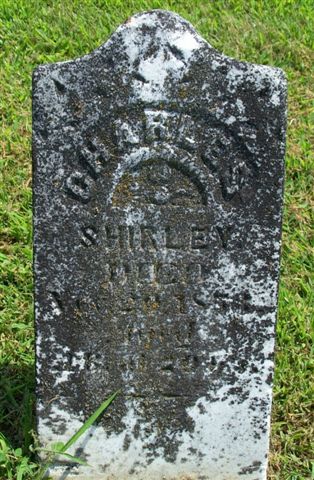 Charles
had borrowed substantially from his mother, so did not participate
in the distribution of her property in 1845. In 1850 Charles
is listed in the 1850 census of Clay Co. IL. It is said by an
old family historian of long ago that Charles was killed by pirates
on the Mississippi River while taking staves to New Orleans.
No will or administration has been found for Charles. William
C. Shirley (b.1839) said: Charles gave up his holdings in
Indiana and moved to Illinois at the same time or before Henry
Shirley went there. I recollect going for a a visit to Charles
and to my Grandfather Henry Shirley's house in about 1842. Charles
lived in a brick house out there on the edge of the plains. In
those days most of the houses were log cabins, and a brick house
indicated real prosperity. It took us about a day to drive from
Grandfather Henry's to Uncle Charles' place. Uncle Charles was
a great hunter. He was not at home when we drove up that evening,
but he soon came in wagging a deer on his back. I was only a
little chap of four or five, so I do not remember much about
the visit. I do recall that there were two wheelbarrows in the
yard, the first I had ever seen. He also had several stands of
bees, and I recollect that Jackson, Adam Shirley's son, and another
boy wheeled the barrows among those bees and got badly stung.
There were two or three women around the house. There was no
timber close to the house. He just lived on the edge of a prairie.
Uncle Charles had formerly lived on the old Hamm place in Orange
Co., and had built a log house and barn there before he moved
to IL. Charles
had borrowed substantially from his mother, so did not participate
in the distribution of her property in 1845. In 1850 Charles
is listed in the 1850 census of Clay Co. IL. It is said by an
old family historian of long ago that Charles was killed by pirates
on the Mississippi River while taking staves to New Orleans.
No will or administration has been found for Charles. William
C. Shirley (b.1839) said: Charles gave up his holdings in
Indiana and moved to Illinois at the same time or before Henry
Shirley went there. I recollect going for a a visit to Charles
and to my Grandfather Henry Shirley's house in about 1842. Charles
lived in a brick house out there on the edge of the plains. In
those days most of the houses were log cabins, and a brick house
indicated real prosperity. It took us about a day to drive from
Grandfather Henry's to Uncle Charles' place. Uncle Charles was
a great hunter. He was not at home when we drove up that evening,
but he soon came in wagging a deer on his back. I was only a
little chap of four or five, so I do not remember much about
the visit. I do recall that there were two wheelbarrows in the
yard, the first I had ever seen. He also had several stands of
bees, and I recollect that Jackson, Adam Shirley's son, and another
boy wheeled the barrows among those bees and got badly stung.
There were two or three women around the house. There was no
timber close to the house. He just lived on the edge of a prairie.
Uncle Charles had formerly lived on the old Hamm place in Orange
Co., and had built a log house and barn there before he moved
to IL.
1820 Orange Co IN Census -
Charles Shirley 200010 - 20100 (age 26-45, 4 children)
1830 Orange
Co IN Census - Charles Shirley 1111001000000 - 3101010000000
(age 40-50, 9 children)
History of
Wayne and Clay Co Illinois (1884) - Charles Shirley came here
from Indiana in 1838. He entered land in Section 14 on which
he settled. He brought his wife Sarah (Ingledove) Shirley and
eight children - Indiana, Alexander, Katherine, Jennette, Huram,
Samuel, Amanda and Mary E. Another son Jennings Shirley came
to Blair Twp in 1837. Of the above children, only Indiana, Jeanete
and Mary E are now living in this county. Charles Shirley was
known as an industrous man and a quiet citizen.
married Sarah
Ingledove
about 1807. She died 22 January 1856 and was buried at
the Old Union Cemetery, Louisville Clay Co IL.
children:
2(i) Daughter
Shirley
born about 1810-1820; This child is indicated by the 1820 census
(age 0-10), but gone from parent's household by the 1830 census
2(ii). Indiana Shirley born about 1810 KY;
Indicated in parent's 1820 census (age 0-10) and 1830 census
household (age 15-20); She married John A. McCauley on 11 December
1838 at Orange Co. IN. (4 children)
2(iii). Jennings
Shirley (male) born
about 1820 IN, age 30; single living in parent's 1850 census
household, age 56 (sic) in 1860 Clay Co IL census, living with
siblings Alexander, Samuel and Amanda and again in 1870 census,
age 65 (sic);
1860 Clay Co. IL Census Jennings,
Alexander, Samuel and Amanda are listed in the same household
1870 Clay Co IL Census Gennings
Shirley age 65 (surname reversed in index), Sam age 40, Amanda
age 38, Mary E age 37, Amandy C age 3
2(iv). Huron
Shirley
born about 1825 IN; He lived in Effingham Co IL in 1860 census,
age 30; Lived at Blair, Clay Co IL in 1870 censusage 50, occupation
farmer; He lived at Louisville, Clay Co Illinois in the 1880
census, age 55, occupation: farmer
married 1)
Susan Summerman; Her
surname is identified in the 1878 marriage of her son William
F Shirley
married 2)
Cynthia Martin sometime
just before the 1860 census (her surname ID in son Andrew's
death cert); She was age 23 in 1860 census, age 35
in the 1870 census
children:
3(i). William
Floyd Shirley
(by 1st marriage) born about 1850 IL, age 10 in 1860 census,
age 20 in parent's 1870 census household; He lived near his father
in Louisville Clay Co Illinois in the 1880 census, married, age
29, occupation farmer
married Rebecca
J Jones on
20 August 1878 in Clay County Illinois, she was age 15 at the
time of marriage, daughter of John Jones and Catherine Hord
children:
4(). David
Francis Shirley
born 12 June 1881 at Louisiville Clay Co IL to W T (sic) Shirley
and wife Rebecca Jane Jones (birth rec)
3(ii). Andrew
J Shirley born
18 June 1856 at Effingham Co IL (death cert), age 3 in 1860 census;
age 11 in parent's 1870 census; Lived at Neoga, Cumberland Co
IL in 1900 census, age 43, married; He died 12 February 1928
at Neoga Cumberland Co IL. age 71, buried at Old Union Cemetery,
Clay Co IL (death cert, parents named)
married Susan
Etta Cameron;
She died in 26 September 1926, buried Old Union Cemetery, Louisville
Clay Co IL
children:
4(i). Harvey
S Shirley born
about 1887 in IL, age 13 in 1900 census
4(ii). Clarence
E Shirley
born about 1890 in IL, age 10 in 1900 census
4(iii). Cora
C Shirley
born about 1893 in IL, age 7 in 1900 census
4(iv). Edith
M Shirley
born about 1896 in IL, age 4 in 1900 census
3(ii). George
W. Shirley born
7 January 1859 IL, age 1 in 1860 census; age 9 in 1870 census,
age 22 in parent's 1880 census household; He died 13 January
1935, buried Old Union Cemetery, Louisville Clay Co IL;
3(iii). Mary
E. Shirley
born about 1865 IL, age 4 in 1870 census, age 15 in parent's
1880 census household
3(iv). Clementine (Susan)
Shirley
born about 1869 IL, age 1 in parent's 1870 census household (as
Susan Shirley), age 11 in parent's 1880 census household
3(v). Roseann
Shirley born
about 1876 IL, age 4 in parent's 1880 census household
2(v). Catherine
Shirley born
1825 IN, a child of this age enumerated in parent's 1830 census
household; She is gone from parent's census household in 1850;
Named as a child of Charles and Sarah Shirley in the 1884 History
of Wayne and Clay Counties Illinois
2(vi). Jeanette Shirley
born 13 July 1825 IN (tombstone); Indicated in parent's 1830
census household (age 0-5), age 75 in 1900 census that included
her "sister" Mary Shirley; She married Silas Ooten
probabily about 1850
2(vii). Alexander
Shirley born
1826 IN, age 24 in parent's 1850 census household, age 48 (sic)
in 1860 Clay Co IL census, living with siblings Jennings, Samuel
and Amanda
1860 Clay Co. IL Census Jennings,
Alexander, Samuel and Amanda are listed in the same household
1870 Clay Co IL Census Gennings
Shirley age 65 (surname reversed in index), Sam age 40, Amanda
age 38, Mary E age 37, Amandy C age 3
2(viii). Mary
E. Shirley
born 1827 IN, Indicated in parent's 1830 census household (age
0-5); age 18 in parent's 1850 census household (sic), Age 30-40
in IL state census; Lived with siblings in 1870 census, age 37
(b 1833); lived with "sister" Jeanette Shirley Ooton
in Clay Co IL in 1900 census, age 73 (b 1827)]
1870 Clay Co IL Census Gennings
Shirley age 65 (surname reversed in index), Sam age 40, Amanda
age 38, Mary E age 37, Amandy C age 3
2(ix). Samuel
Shirley born
1828 IN, age 22 in parent's 1850 census household, age 27
(sic) in 1860 Clay Co IL census, living with siblings Jennings,
Alexander and Amanda, and again in 1870, age 40 (b 1830)
1860 Clay Co. IL Census Jennings,
Alexander, Samuel and Amanda are listed in the same household
1870 Clay Co IL Census Gennings
Shirley age 65 (surname reversed in index), Sam age 40, Amanda
age 38, Mary E age 37, Amandy C age 3
2(x). Amanda
Shirley
born 1830 IN, Indicated in parent's 1830 census household (age
0-5); age 20 in parent's 1850 census household, age 24 (sic)
in 1860 Clay Co IL census, living with siblings Jennings, Alexander
and Samuel, and again in 1870 census, age 38
1860 Clay Co. IL Census Jennings,
Alexander, Samuel and Amanda are listed in the same household
1870 Clay Co IL Census Gennings
Shirley age 65 (surname reversed in index), Sam age 40, Amanda
age 38, Mary E age 37, Amandy C age 3
History of
Clay Co Illinois - Jesse Blair died in 1883, he was from Orange
County, Ind., and was seventy-three years old when he died; he
married Ann Shirley (sic, Amanda), daughter of Charles Shirley.
1(vi). Adam
Shirley
born July 17, 1786, died
1842-43, Shirleys
of Washington County Mississippi
Adam appears to have gone to
Orange Co. IN in 1815 along with the others of the family. Land
had been entered for him there in 1813. The history of Orange
Co. states that he was appointed a Justice of the Peace in 1817
and that he voted in Northwest Twp in 1819. In 1819 he officiated
at a marriage. Adam appears to have gone to Orange Co.
IN in 1815 along with the others of the family. Land had been
entered for him there in 1813. The history of Orange Co. states
that he was appointed a Justice of the Peace in 1817 and that
he voted in Northwest Twp in 1819. In 1819 he officiated at a
marriage. Adam owned 80 acres and
about 1820 the county authorized him to build a toll bridge over
Lost River on his land. The bridge was never built. In 1830 he
transferred the land to his brother Charles. It appears that
Adam lived for a short time in Martin Co. which adjoins Orange
Co. On Aug 12, 1819 he entered 320 acres but later relinquished
the claim. In 1820 he ran for sheriff of Martin Co. IN and won,
receiving 68 votes versus 60 for his opponent. His election was
disallowed because he had not qualified as a resident of Martin
Co for 12 months. He is not listed in the 1820 Indiana census
index. An Orange Co. IN Court record shows he was unmarried in
Feb 1818. In 1830 Adam appears on the census for
Washington Co. Mississippi. His wife was 20-29, 3 females 10-14,
1 female 5-9 and 1 female under 5 with no slaves. In 1840
he was 50-59, with a male 30-39, a female 30-39, a male 5-9,
2 girls under 5, and 2 slaves. On May 14, 1839, Adam executed
a deed of trust naming his wife Elleander and children Andrew,
Martha and Missouri, also eight slaves. By this deed Adam mortgaged
a plantation of 671.5 acres in Washington Co. Mississippi, Book
1` page 279. William C. Shirley
wrote about 1925 that... Adam Shirley went south, locating in
Mississippi and had a plantation and Negro slaves. He married
and had two children. His wife died and he was killed by his
overseer. His children, quite small, were brought north and raised
by Jacob and Henry Shirley (brothers of Adam). Their names were
Jackson and Missouri. Jackson Shirley learned the tinner's
trade at Paoli in Orange Co. IN under the system then in vogue,
after which he settled near Kokomo in Howard Co. IN. and married.
married Elleander ___.
1(vii). Anna
Elizabeth (Betsey) Shirley born
Feb 19, 1790, died Jan 5,
1881, m. Andrew Wilson Dec 25, 1815. He was born Aug 5, 1789
VA and died Oct 7, 1853. They were the parents of 7 children.
(See MISC INFO at the top of this page to see a pedigree of
this family)
Anna Elizabeth was called Betsey and in her father's (Valentine)
will she was bequeathed a brown mare named Jin and her colt and
2 cows, or $124, also 1 good feather bed and furniture, as well
as her equal share of the estate. At the sale in 1811 she bought
a black filly for six pounds six shillings. The final settlement
of Valentine's estate shows that she chose the money instead
of the animals and that she also received $267. Betsey with her
mother and others of her family came to Indiana in 1815. On July
7, 1815 she entered 160 acres in Paoli Twp, Orange Co. IN. She
was the first woman to enter land in the township and the only
woman among 121 persons who entered land there through 1819 according
to the history of Orange Co IN.
1(viii). Anna
Catherine Shirley Feb
29, 1792 VA, d. Nov 18, 1833, m. Thomas Sewell Oct 6, 1814. He
was born Nov 6, 1791 and d. Aug 10, 1834. They were the parents
of 5 children. (See MISC INFO at the top of this page to see
a pedigree of this family)
Anna was 19 when her father died. He bequeathed her a horse
and two cows, or $124, and one good feather bed and furniture
in addition to her share of the estate. Her only purchase at
the sale on Nov 7, 1811 was a desk for four pounds, one shilling.
In the final settlement of the estate her share was $310.13 plus
the $124 in place of the animals. Anna signed a deed in Augusta
Co. VA on June 16, 1814, and after her marriage to Thomas Sewell
on Oct 6, 1814, she and Thomas both signed the deed.
|


 Valentine Shirley